By Mona Clayton, aka Rookie Birdher
Certified Access Birding Outing Leader and Board Member for Indiana Audubon.
“What’s the brown bird at feeder C?”
“Hairy or Downy? What do you think?”
“Look—there’s a Pileated Woodpecker!”
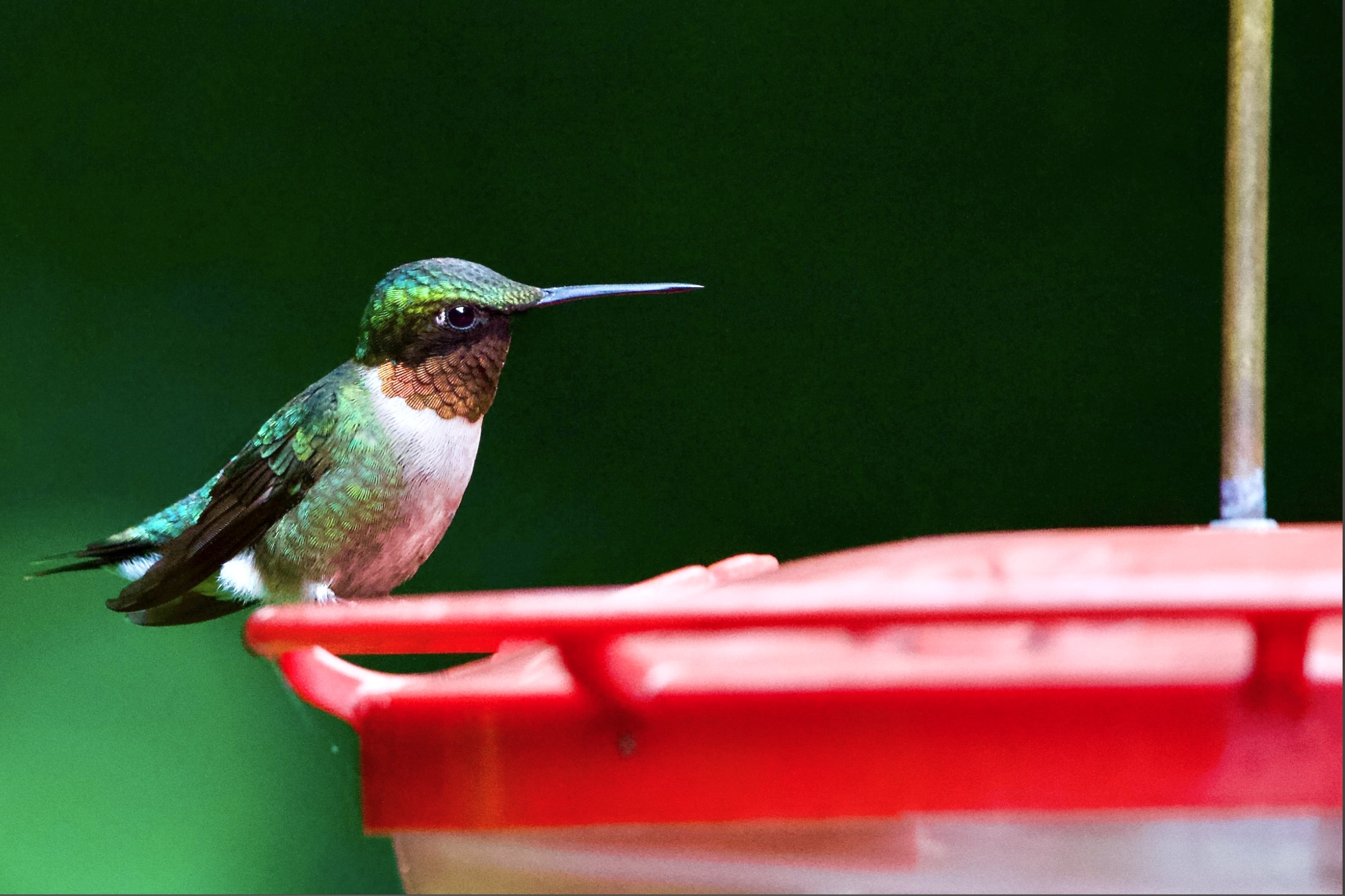
“Oooh, oooh, a hummingbird!”
There is a feeder observation room at Eagle Creek Park’s Ornithology Center, or the OC, where bird activity unfolds naturally outside large windows as participants settle into conversations, questions, and shared observations.
At a feeder watch, the birds come to you rather than the other way around, allowing participants to observe at their own pace. Feeder stations and nearby trees are labeled and numbered, making it easy to point out birds as they arrive.
Each time a male Ruby-throated Hummingbird zipped in to feed just beyond the bird-safe windows, conversations paused and excitement grew as participants shifted their gaze for close-up looks at the tiny visitor.
***
I was delighted to receive an invitation to lead the accessible feeder watch during Eagle Creek’s annual bird festival, Bird Fest.
To prepare, I visited the OC the day before around the same time as the scheduled feeder watch, observing feeder activity while devising a loose plan for the outing. I imagined eventually stepping outside with my spotting scope to visit nearby feeders, stroll to the viewing platform, and perhaps observe the nesting cormorants nearby.
Spoiler alert: we never made it outside.
***
After a motor vehicle accident changed my view and expanded the ways I participate in birding outings, I pursued training as a Certified Access Birding Outing Leader (CABOL) through Access Birding. The course encouraged learners to think more intentionally about welcoming every body, especially people with disabilities, and how factors such as understanding participant access needs, pacing, seating, shade, trail surfaces, communication, and outing expectations can shape participation and access in birding spaces.
On Sunday, I arrived ahead of time with spotting scope and tripod as I expected we would eventually venture outside the OC. I located the bin of loaner binoculars and distributed several pairs before making a few additional dashes to ensure there were enough for everyone. For some first-time binocular users, we did a quick intro on adjusting focus and getting the target (bird) in the view.
What struck me most during the feeder watch was the wide variety of people who drifted in and out: young families, empty nesters, longtime high school friends birding together in their 30s, a solo photographer ready to take a break and sit, grandparents attending with children and grandchildren, experienced birders, and festival visitors who initially wandered in simply looking for the restroom before lingering to watch the feeders. A few arrived before me and stayed the entire time.
The feeder watch became a buzzing multi-generational space, with participants ranging from toddlers to octogenarians.
Unfamiliar bird? Let’s figure it out.
Questions and observations continued throughout the feeder watch. One couple mentioned the many cardinals visiting their feeder at home and wondered why some looked different from the familiar bright-red males and buff-colored females. We consulted a bird ID app on my phone and there it was—a juvenile cardinal with the black bill which eventually changes to orange.
We dove deeper into identifying female species. A few minutes later, participants were calling out the female Red-winged Blackbird at the feeder. See one, do one, teach one—in real time!
Knowing a Fish Crow was calling outside, I played the call so participants would recognize it whenever they ventured outdoors. Several remarked they had heard the call before but did not realize a species called Fish Crow existed.
Neither did I until 2022.
Accessible birding outings are still relatively uncommon at birding festivals, especially those accommodating participants spanning more than eight decades of age and experience in a single outing. Yet for ninety minutes inside the OC, the feeders became a shared space for learning, curiosity, conversation, and discovery.
I’m grateful to Eagle Creek for creating space where participants of all ages, abilities, and experience levels could enjoy birding together. Some participants arrived with cameras and years of birding experience. Others picked up binoculars for the very first time. Everyone participated differently.
We had time to talk about bird ID apps and upcoming outings and events. Ninety minutes of birding community inside the OC, and I walked away grateful and encouraged.
I’ve noticed some birders make a distinction between birding and birdwatching. For me, there’s no hierarchy. We are all birding.
Bird on!
Editor’s Note: You can follow Mona’s birding adventures and book virtual classes at Rookie Birdher on Facebook and @rookie_birdher on Instagram