
By Mary Ellen Gadski
International Projects Coordinator for Bird Alliance of Central Indiana
Several years ago, a leader of the Central Indiana Beekeepers Association told me that every time his neighbor across the street had a mosquito fogging application to her front yard, his driveway was covered with dead bees. I was stunned by this terrible result of drift. Clearly, mosquito fogging presents a serious consequence to beekeepers, but it also poses risks to birds.
***
Here’s a little background on a fast-growing trend in which people hire pesticide companies to fog their properties. Seven years ago, I saw the first sign for The Mosquito Authority in a neighbor’s front yard. I wondered what this company was all about. I called the number on the sign and spoke to a woman at the franchise office. I asked her: “How do you protect the bees?” She responded: “Oh, we shake the bushes first.” That seemed like a ridiculous answer.
During the pandemic summer of 2020, when everyone was home, a salesperson for Mosquito Squad knocked on my door and said: “Your next-door neighbor has just signed up, and we can offer you a great deal.” I said, “No thanks” and shut the door. A few weeks later, a second solicitor came around. This time I was prepared with many questions. He reassured me that the product was “family-friendly” since “it’s from flowers.” That ill-informed remark launched my research.
I found it indisputable that fogging with synthetic pyrethroids kills ALL insects, not just mosquitoes, a practice that one critic called “ecocide.” To list the insects that most people view as beneficial, that means butterflies, ladybugs, fireflies, and bees are all killed by fogging. But beyond the favorites, insects are the foundation of the web of life, the basis of the food chain. This is just basic biology, which most of the companies ignore.
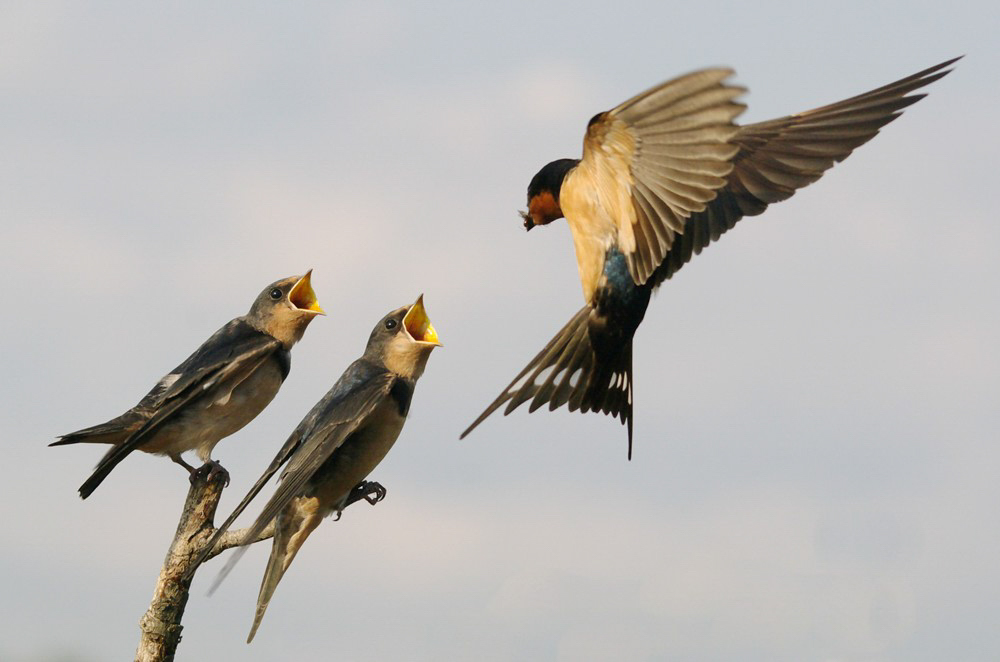
I was aware that birds are suffering a decrease in their food supply. Did you know that 90% of birds feed their young insects? A Cornell study of the diet of hummingbirds concluded that small arthropods (spiders) comprised a large percentage of the nestlings’ food. Yes, fogging kills spiders. Many aerial insectivores like Barn Swallows are in decline because there are fewer insects to eat; 2 in 5 of them have been lost since 1970. In the past few years, I have read articles and heard scientists referring to the “insect apocalypse.” Do you remember when we had to clean accumulated dead bugs from our windshields after a drive in the countryside? That rarely happens anymore.
***
What about the effects on human health? To know more about the health threats of synthetic pyrethroids, I started by reading the chemicalWATCH factsheet produced by Beyond Pesticides of Washington, D.C.
Pesticide products containing pyrethroids are often described by pest control operators and community mosquito management bureaus as “safe as chrysanthemum flowers.” While pyrethroids are a synthetic version of an extract from the chrysanthemum, they were chemically designed to be more toxic with longer breakdown times and are often formulated with synergists, increasing potency and compromising the human body’s ability to detoxify the pesticide.
The factsheet goes on to say that tests of some pyrethroids on laboratory animals reveal striking neurotoxicity when administered by injection or orally. The World Health Organization explains that synthetic pyrethroids are neurotoxins that act on the axons in the peripheral and central nervous systems. The Environmental Protection Agency classifies some pyrethroids as possible human carcinogens.
So, what is the EPA doing? For several years, it has been re-evaluating pyrethrins, all pyrethroids, and two synergists. When the pesticides were first authorized for use, no one could have foreseen that these chemicals would be used in backpack foggers, which have become far more powerful in recent years. Years ago, I heard Seth Dibble, a representative of EPA’s Region 5 office in Chicago, describe his agency’s slow process this way: “It’s like moving the stone in curling!” Under the current federal administration, can we expect the EPA to speed up and decide conclusively that the pyrethroids are unsafe? Probably not when big business and pesticide companies form a powerful lobby.
***
Mosquito fogging is quite a growing phenomenon as people value their comfort outdoors over all other considerations, even if it is clearly a threat to nature and possibly to their health. It also appears to be a profitable business, as more and more companies are getting into fogging. Did you know that local companies come to fog every 14-21 days from the end of March to the end of October? On March 28 one year, Mosquito Joe fogged our next-door neighbor’s yard on a morning when there was frost on the roofs and it was 28 degrees. How many mosquitoes do you think they killed that day? Then they came on October 25; we had a killing freeze a few days later. These two days are representative of completely unnecessary overloads of insecticides!
The Xerces Society, a conservation group generally most often associated with butterflies, funded a study on mosquito fogging conducted by scientists at the University of Nevada, Reno. Their article was published in the scientific journal Stacks in December 2025. They found that contamination levels were higher in yards fogged by private companies than in yards sprayed by local mosquito control districts. In Marion County, the Board of Health is responsible for the trucks that travel down neighborhood streets. The difference is that the health department sprays only when there is a health risk from mosquitoes, such as when West Nile virus was killing people here. And they spray at night, when insects are less active, not during the 9-5 workday. Last year I don’t think a truck went down our street all summer.
For the Xerces Society study, volunteers in Georgia, Iowa, and Massachusetts placed monitors in their yards before mosquito spraying in their own yard, in a neighboring yard, or by a mosquito control truck. The yards sprayed for mosquitoes by private companies had the highest levels of contamination, high enough to kill bees or other beneficial insects. In fact, yards directly sprayed by private companies had over six times the amount of insecticide lethal to honeybees, with a maximum of over 34 times the lethal dose. And 75% of samples from the yards next door had pyrethroid contamination from drift, some of them twice the lethal dose. Sprays by control districts had the lowest levels of residue.
***
So, what can we do to take action? One of the first things we can do is to talk to neighbors who hire Mosquito Joe and his friends. Educating people on this issue is very important. Put up a sign in your yard—it may persuade your neighbors to stop having their yards fogged (or others from signing up).
But most importantly, if you can see the drift from fogging coming on to your property, you have the right to submit a complaint to the Office of the Indiana State Chemist at Purdue University. To help your case, you may include photographs and videos of the applicator in action close to your property line. With the new high-powered backpack foggers, the spray seems to be more visible; use your cell phone to document it coming into your yard.
At the Indiana Pesticide Review Board’s meeting in February 2022, David Scott, its former administrator, stated clearly: “Individuals may take risks for themselves, but it’s not okay for them to decide for their neighbors.” Please keep this in mind. The Office of the Indiana State Chemist needs to hear from those who are negatively affected by drift from mosquito fogging. There is a far greater understanding of the importance of pollinators now than there used to be. In fact, there is state policy on protecting pollinators. Unless people submit complaints, there is no way to quantify the scope of the problem.
At the May 2026 ABAS (now BACI) program meeting, the American Bird Conservancy’s Director of the Pesticides and Birds Campaign, Hardy Kern, gave an excellent talk on what’s happening nationally to control pesticides that are detrimental to our beneficial insects and our birds. Most birders are familiar with the 2019 study concluding that 3 billion birds have been lost since 1970. Kern stated that pesticide use is the most direct corollary with the loss of birds. Please help spread the word about how mosquito fogging is contributing to the alarming downward trend.
Mary Ellen’s writing on the harmful effects of mosquito fogging has “gone national” with the publication of an article in Chesapeake Wildlife Heritage’s magazine Habitat Works, winter 2026 issue.
Top Image Credit: Philip Yabut/Audubon Photography Awards
Investigation: Lethality of Mosquito Fogging: Results in the Real World
By William L. Murphy
Former Editor for Bird Alliance of Central Indiana and entomological Research Collaborator
I’m a research associate with the Smithsonian Institution’s Department of Entomology. After studying the Xerces-sponsored study, I decided to explore the potential harm to honeybees from pyrethroids, through either contact with droplets of spray or with sprayed plants or flowers. The results of the study were presented in a way that suggests the tested treatments were at least marginally compatible with pollinator safety, but when I envisioned a honeybee in a real-world scenario, I reached a very different conclusion.
The study evaluated toxicity primarily by estimating the toxicity of a single exposure (dose) with that of an LD50—the dose expected to kill 50 percent of exposed individuals. But a bee foraging in a treated area is highly unlikely to encounter a pesticide only once before leaving. It may visit dozens or hundreds of contaminated flowers, repeatedly contacting residues and ingesting contaminated nectar and pollen. Each exposure adds to the bee’s cumulative dose. A single-exposure analysis may therefore substantially understate the danger that pesticides pose under real-world foraging conditions.
To estimate how quickly a honeybee might receive a lethal cumulative dose from visits to multiple flowers, I made several simplifying assumptions: 1) that each flower offers the same amount of nectar over an effective surface area of 1 cm2 regardless of its size or species, 2) that composite flower heads, such as dandelions, provide the same total amount of nectar as individual flowers, 3) that pesticide particles are infinitely small and uniformly dispersed over each flower, and 4) that all flowers are treated as flat despite their three-dimensional structures. These assumptions reproduce most details of natural foraging and provide a straightforward way to evaluate the implications of the study’s own measurements.
Using the data reported in the paper, I calculated the minimum number of visits to contaminated flowers that would be required for a honeybee to accumulate an LD50. For simplicity, I focused on pyrethroids. According to the Pesticide Properties Database cited by the authors, the average LD50 of pyrethroids for honeybees is about 0.1 mg per kilogram of body weight. The average worker honeybee weighs 0.0001 kilograms, which corresponds to an LD50 of about 10 ng of pyrethroids per bee.
The lowest contamination level recorded in the study was 0.57 ng/cm2, which a honeybee would accumulate after imbibing nectar from only about 18 flowers. I observed honeybees foraging at 75°F. in my suburban yard in Fishers, Indiana, and noted that they spent about seven seconds on each flower. At that rate, a honeybee could visit 18 flowers in just over two minutes. Allowing additional time for movement between flowers, a honeybee could accumulate an LD50 in roughly three minutes, even at the lowest contamination level recorded in the study.
This calculation is necessarily an estimate. The actual dose absorbed by a honeybee would depend upon such factors as flower structure, residue distribution, weathering, pesticide uptake, and the amount of nectar and pollen collected. Nevertheless, this calculation exposes a serious weakness in evaluating pollinator safety primarily through isolated, single-contact exposures. A concentration that appears tolerable when based upon one exposure at a time may be lethal to honeybees after only a brief period of foraging.
Moreover, the lethality may extend far beyond the spray zone. Comparable residues settle on pollen as well as on nectar and floral surfaces. A honeybee that survives long enough to return to the hive may carry contaminated pollen collected from dozens of flowers. That pollen will be consumed or stored by nurse bees, larval honeybees, and other members of the hive. The result is not merely the isolated exposure of one honeybee but a potential pathway by which pesticide contamination can enter and circulate throughout the hive.
The central question, therefore, should not be whether a single droplet or contact event contains a lethal dose. It should be how rapidly ordinary foraging by a honeybee can amass a cumulative lethal dose and how much contaminated nectar and pollen a honeybee may carry back to the colony before the effects become apparent. By focusing on isolated exposures, the study may present a dangerously incomplete picture of the actual risk to honeybees and other pollinators.
Bill has published nearly 100 peer-reviewed papers and book chapters on various entomological topics, including the chapter on insect pests of honeybees in Honey Bee Pests, Predators, and Diseases, by R.A. Morse and R. Nowogrodzki (eds.).