By Jesse Greene
Outreach Manager for Bird Safe Indy
You’ve started noticing the birds around you. A cardinal at the feeder, a hawk overhead, a warbler passing through during migration. The next question is usually how to go from noticing birds to actually engaging with them, whether that means getting more involved in the hobby itself or taking steps to help the birds you’re watching, through counts, surveys, or small changes at home. In Central Indiana there are a handful of ways to do both, and none of them take much experience to get started. Some just mean paying closer attention to what’s already in front of you. Others are small changes around your own house that end up mattering more than you’d think.
Keep a Checklist
Probably the easiest thing you can do as a new birder is start keeping a checklist. eBird, a free platform out of the Cornell Lab of Ornithology, lets you log what you’re seeing wherever you happen to be, on a walk, at a park, or just sitting on your own porch. It sounds small, but that data actually gets used by researchers tracking migration timing and population trends across the country.
You don’t need to get every ID right to take part. Merlin Bird ID, also from Cornell, will suggest what’s likely nearby based on your location and even the sounds it picks up through your phone’s mic. Start a list over morning coffee some weekend. It adds up faster than you’d expect, and there’s something genuinely satisfying about watching it grow.
Go on a Walk
If you’d rather learn with people around you, local bird walks are probably the fastest way to build your ID skills. Cool Creek Park and Eagle Creek Park both run regular walks that bring together birders at every level, and walking next to someone who knows a call you don’t is usually the quickest way to pick it up yourself. These are free, casual, with no gear or experience required, just show up curious.
The two parks are pretty different, too. Eagle Creek’s mix of woodland, wetland, and reservoir pulls in a wide range of species, while Cool Creek’s smaller trails make it easier to get close looks without covering a lot of ground. Bouncing between a few different walks over a season is a good way to see how much is actually out there within a short drive of downtown. BACI’s calendar has walks posted across the eight-county service area throughout the year.
Take Part in a Count
Beyond your own checklisting, the Indy region also takes part in bigger citizen science events like the Christmas Bird Count and the Great Backyard Bird Count. These are single-day or single-weekend pushes where birders everywhere report what they’re seeing, and that local participation feeds straight into population data that’s been tracked for decades. It’s also just a good excuse to get outside for a morning with other people, and a reason to be looking up.
The Problems, and the Easy Fixes
Local birds run into a handful of well-known problems, and most of the fixes are simpler than you’d expect.
Window collisions are one of the bigger ones. Birds can’t read glass as a barrier, especially with reflections, so a lot of them fly straight into it, particularly during migration. A pattern of dots applied to the outside of a window breaks up that reflection and gives birds something to register as solid. It’s a small, physical fix, and it works whether it’s on a house, a business, or a nature center.
Light pollution is the other big one. A lot of species migrate at night and rely on natural light to navigate. Bright, unshielded lighting throws that off and increases the odds of a collision. The fix is about as easy as it gets: turn off outdoor lights you don’t actually need, especially during peak migration in spring and fall.
Neither of these takes special training or much time. Putting dots on a window or flipping off a porch light are both things you could do this week.
Where to Start
Pick one thing. Start a checklist in your yard. Show up to a walk at Cool Creek or Eagle Creek. Put dots on a window birds keep hitting. Turn your lights off during the next migration push. If you want to get more involved beyond that, you can sign up for a survey with BACI. None of it has to happen all at once.
For more information and upcoming events with ABAS and Bird Safe Indy, visit https://www.birdallianceofcentralindiana.org/volunteer/
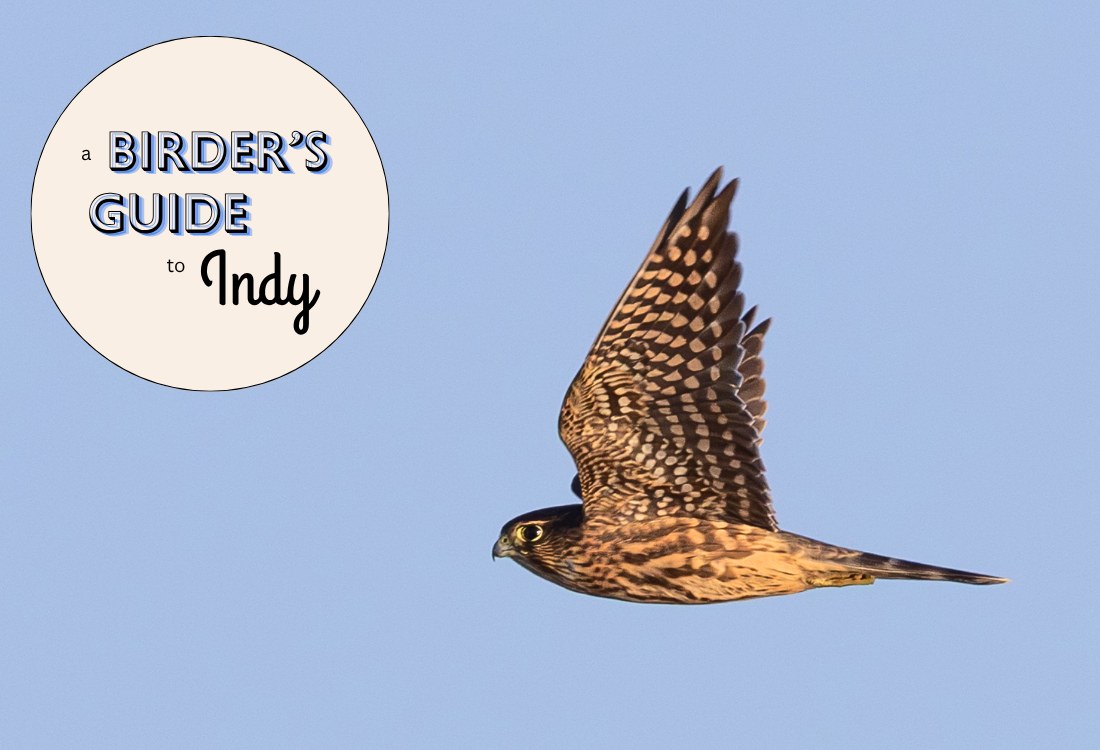
Merlin. Photo by Robin Janson